
Custom Orthotics in Urbandale, Iowa: Correcting Arch Collapse and Supporting Whole-Body Alignment
Medically Reviewed by Dr. Kyle Ruehle, DC — Advanced Spine Health Center, Urbandale, Iowa
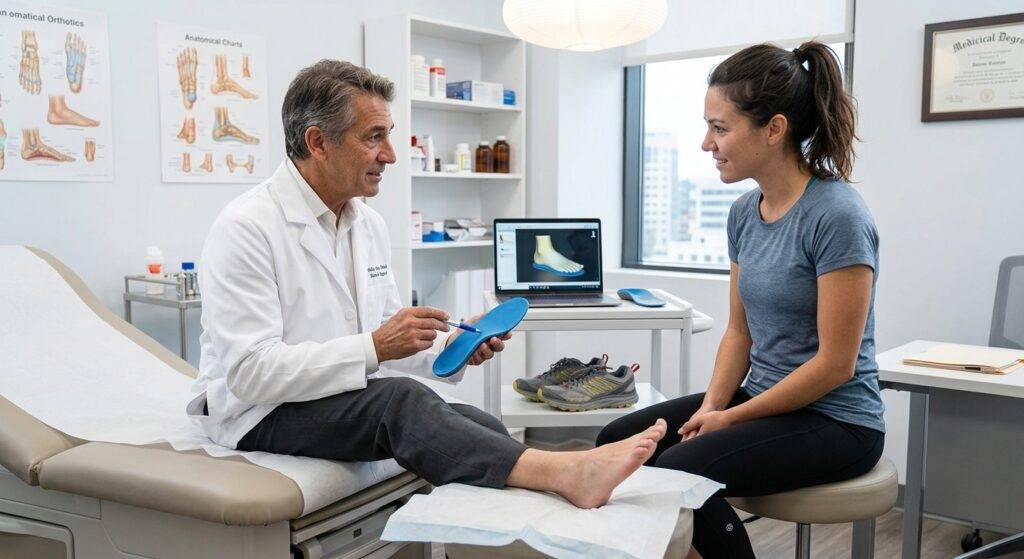
Your feet are the foundation for everything above them. When an arch collapses more than it should under load — what's often called arch drop — the effects don't always stay in the foot. They can travel up through the ankle, knee, hip, and even the low back, changing how those joints absorb force with every single step.
At Advanced Spine Health Center in Urbandale, Iowa, we evaluate arch drop with 3D imaging rather than guesswork, and when a custom orthotic is appropriate, we build it through MojoFeet, a lab whose casting philosophy fits closely with how we already think about structure and correction. This page explains what arch drop actually is, how we measure it, how MojoFeet's approach to building an orthotic differs from a standard drugstore insert, and what the evidence does and doesn't support.
Table of Contents
What Is Arch Drop? | How We Evaluate Arch Drop | The MojoFeet Approach | Custom vs. Prefabricated Orthotics | Conditions Orthotics May Help | What the Research Shows | Beyond the Foot: How This Fits Into a Larger Plan | Who's a Candidate | What to Expect | FAQ | Schedule a Consultation
What Is Arch Drop?
The arch of your foot isn't just a shape — it's a spring. It's supposed to flatten slightly under load to absorb shock, then return to its normal height as your foot pushes off. Arch drop happens when that flattening goes further than it should, and the arch doesn't recoil the way it's designed to.
Clinically, this is often described in terms of foot pronation — the inward roll and flattening of the foot during standing and walking. A certain amount of pronation is completely normal. The question isn't whether the foot moves, it's how much, and whether that amount is contributing to a problem somewhere in the body.
One long-standing way to measure this is the navicular drop test, which compares the height of a specific bone in the arch (the navicular) between a relaxed sitting position and full standing weight-bearing.1 A larger difference between those two measurements generally indicates a more collapsed, more mobile arch. This concept — comparing an unloaded or corrected arch position against a loaded, standing position — is the same basic principle behind more modern 3D measurement methods, including the one we use in our office.
How We Evaluate Arch Drop at Advanced Spine Health Center
Rather than relying on a hand-held measurement alone, we use the MojoMatrix digital imaging system, a pin-array scanner that captures two 3D models of each foot:
- A seated scan of the foot held in a corrected, supported posture
- A standing scan of the same foot bearing full body weight
The MojoMatrix software then compares the two 3D models directly and calculates a percentage of arch drop — a specific, repeatable number rather than a subjective impression of "flat feet." That percentage is what actually drives our recommendation:
- Mild to moderate arch drop — we typically recommend a prefabricated orthotic, since the correction needed is usually well within what a quality prefab can provide.
- Severe arch drop — we typically recommend a custom orthotic, built specifically around that patient's own corrected foot position.
This is worth being direct about: a custom orthotic isn't automatically the "better" choice for every patient. It's the appropriate choice when the measured severity calls for it. Basing that decision on an actual measurement, rather than defaulting to custom for everyone, is part of what we mean by an individualized evaluation.
The MojoFeet Approach to Custom Orthotics
When a custom orthotic is appropriate, we build it through MojoFeet, a lab founded by a chiropractor with a bioengineering background. Their underlying philosophy is straightforward: modern life — hard, flat surfaces, shoes, and long hours of sitting — has changed how our feet are used compared to how they evolved to function, and a orthotic's job is to support the foot back toward a more functional position rather than simply cushion it.
What sets their process apart is the casting position itself. Many orthotic labs cast the foot in a neutral position and control motion from there. MojoFeet casts the foot in a corrected, higher-arched position — the seated scan captured on the MojoMatrix — with the goal of supporting the foot's full functional range rather than locking it into one static position. That 3D scan is then used to drive a pin array that precisely recreates the corrected shape, over which a high-density polyethylene shell is thermoformed and vacuum-pressed to the patient's exact foot geometry.
The result is an orthotic built from that individual patient's own corrected arch position, not pulled from a pre-made library of generic foot shapes.
Custom vs. Prefabricated Orthotics: What's the Real Difference?
Both custom and prefabricated orthotics have a place in care — which one is appropriate comes down to the severity of arch drop we measure, not a blanket assumption that custom is always superior. Here's how they generally compare:
| Factor | Prefabricated Orthotics | Custom Orthotics |
|---|---|---|
| Fit | General shape sized to foot length/width | Built from a 3D scan of the patient's own corrected foot position |
| Arch support strength | Moderate, fixed level of support | Stronger support, with rigidity calibrated to the patient's body weight |
| Customization | Limited — generally not modifiable | Can incorporate additions for specific needs, such as metatarsal or big-toe support |
| Best suited for | Mild to moderate measured arch drop | Severe measured arch drop |
| Cost | Lower | Higher — see our pricing page for current details |
Conditions Custom Orthotics May Help
Orthotics are most directly studied for conditions originating in the foot itself, though their influence can extend further up the kinetic chain in some patients.
Plantar Fasciitis and Heel Pain
This is the condition with the strongest evidence base for foot orthoses generally. When the arch collapses excessively with each step, it places repetitive strain on the plantar fascia, the band of tissue running along the bottom of the foot.
General Foot Fatigue and Arch Pain
Patients with significant measured arch drop often notice foot fatigue, aching, or pain that builds throughout the day, particularly with standing or walking-heavy work.
Knee Pain
Excessive foot pronation can influence how the tibia and femur rotate during walking, which may contribute to knee pain in some patients — particularly around the kneecap. This is one area where a foot-focused evaluation and a knee-focused evaluation genuinely overlap.
Hip and Low Back Discomfort
Some patients with significant arch collapse also deal with hip or low back discomfort that appears related to how their gait pattern loads the pelvis and spine. This connection is plausible and observed clinically, but as the research section below explains, it isn't as firmly established as the foot-specific evidence.
What the Research Shows
Evidence quality varies meaningfully depending on the condition, and it's worth being honest about where that evidence is strong, where it's genuinely mixed, and where it's still developing.
Plantar Fasciitis and Heel Pain: Moderate, Reasonably Consistent Evidence
A 2018 systematic review and meta-analysis in the British Journal of Sports Medicine found moderate-quality evidence that foot orthoses reduce pain in the medium term (7–12 weeks), though the clinical significance of that improvement remained somewhat uncertain.2 A separate 2018 systematic review using much of the same underlying evidence reached a more skeptical conclusion, finding that foot orthoses were not clearly superior to other conservative treatments.3 Both papers were published in the same journal within months of each other — a good illustration of how two careful research teams can weigh overlapping evidence differently. An earlier 2011 systematic review found that customized functional foot orthoses reduced pain and improved functional ability compared to no treatment, though the number of high-quality trials available was limited.4 Taken together, the honest summary is: foot orthoses appear to help many patients with plantar fasciitis, particularly over several weeks, but they aren't a guaranteed or universal fix.
Knee Osteoarthritis: Evidence Depends Heavily on the Specific Case
French clinical practice guidelines, developed through a formal review of the evidence, concluded that pronation-correcting foot orthotics can be recommended specifically for medial knee osteoarthritis, with a moderate (Grade B) level of evidence for symptomatic benefit and reduced anti-inflammatory medication use — but the same review found no evidence of a structural or functional effect on the arthritis itself, and no validated reason to prescribe foot orthotics for knee or hip osteoarthritis outside that specific clinical picture.5 In other words, foot orthotics have a genuine, evidence-supported role for a specific subset of knee arthritis patients — not knee pain in general.
Low Back Pain: Emerging but Still Low-Quality Evidence
This is the area where the evidence has shifted the most recently, and where we want to be the most careful. A 2014 systematic review and meta-analysis found no significant benefit of shoe insoles or orthoses for treating or preventing low back pain.6 A more recent 2025 meta-analysis of seven randomized trials reached a more favorable conclusion — finding that foot orthoses significantly reduced pain and disability compared to no treatment, with custom-made thermoplastic orthoses specifically showing benefit — but the authors themselves rated the overall quality of that evidence as low.7 We think that's the fair way to describe where things currently stand: promising and directionally positive, particularly for patients with a pronated or flat foot pattern, but not yet the kind of high-quality evidence that supports a confident guarantee.
Beyond the Foot: How This Fits Into a Larger Plan
An orthotic addresses what's happening at ground level. When a patient's knee, hip, or back pain seems to be connected to how their foot is loading with each step, we may recommend a custom or prefabricated orthotic alongside the other structural and functional care we already provide — including chiropractic adjustments, corrective exercise, and, when appropriate, spinal decompression or corrective traction. The orthotic isn't meant to replace that broader evaluation; it's one piece of it, for the patients whose foot mechanics are genuinely part of the picture. Not every knee, hip, or back complaint traces back to the foot, which is exactly why we measure arch drop directly rather than assuming it's a factor for everyone who walks through the door.
It's also worth noting that arch drop and leg-length differences are two different things we evaluate separately. If an X-ray shows a true leg-length discrepancy, that's typically addressed with a heel or shoe shim rather than an arch-support orthotic — the two tools solve different problems, and a patient may need one, both, or neither depending on what we actually find.
Who's a Good Candidate for Custom Orthotics?
Good candidates for a custom orthotic generally have measurable, severe arch drop confirmed on evaluation, foot or lower-extremity symptoms that seem connected to how the arch is functioning, and a willingness to break the orthotic in gradually rather than expecting instant, effortless results. Patients with milder, measured arch drop are often better served by a quality prefabricated orthotic, which may accomplish the same goal at a lower cost.
Custom orthotics aren't the right starting point for every foot complaint — some conditions call for a different kind of care entirely, and a thorough evaluation is what tells us the difference.
What to Expect
The Evaluation
We start with a history and examination, then use the MojoMatrix to capture both the seated corrective-position scan and the standing weight-bearing scan of each foot. The software compares the two and calculates your percentage of arch drop, which we review with you directly.
The Decision
Based on that measured severity, we'll recommend either a prefabricated orthotic or a custom orthotic built through MojoFeet from your own scanned foot position.
Break-In Period
Any new orthotic changes how your foot is loaded, so we recommend easing into daily wear gradually rather than switching to all-day use immediately. How quickly you can progress varies from patient to patient, and we adjust that timeline based on how your feet are actually responding rather than a fixed schedule that applies to everyone.
Frequently Asked Questions
What's the difference between arch drop and flat feet?
Flat feet usually describes the visible shape of the foot at rest. Arch drop specifically refers to how much the arch collapses when it goes from unloaded to fully weight-bearing — someone can have a normal-looking arch at rest and still show significant drop under load, which is why we measure the change rather than the static shape.
How is the MojoMatrix scan different from a standard footprint or foam mold?
A footprint or a single mold captures one position. The MojoMatrix captures two 3D models — a corrected seated posture and a full standing posture — and calculates the actual percentage of change between them, which gives us a specific severity measurement rather than a single static impression.
Will I automatically need custom orthotics?
No. Whether we recommend prefabricated or custom orthotics depends on your measured arch drop. Many patients with mild to moderate findings do well with a quality prefabricated orthotic.
Can orthotics fix my knee or back pain?
They may help when foot mechanics are genuinely contributing to the problem, but they aren't a guaranteed fix for knee or back pain on their own. That's part of why we evaluate the whole picture — structure, movement, and function — rather than treating the foot in isolation.
How long does it take to get used to custom orthotics?
This varies by patient. We recommend a gradual break-in period and adjust the pace based on how your feet are tolerating them, rather than a fixed number of days for everyone.
Are custom orthotics covered by insurance?
Coverage varies by plan. Our office can help you understand your specific benefits.
Custom Orthotics in Urbandale, Iowa
If you're dealing with foot pain, arch fatigue, or knee, hip, or back discomfort that might be connected to how your feet are functioning, the first step is an actual measurement rather than a guess. At Advanced Spine Health Center, we use 3D imaging to quantify your arch drop and build a recommendation — prefabricated or custom through MojoFeet — around what we actually find.
Contact Advanced Spine Health Center in Urbandale, Iowa to schedule an evaluation. We serve patients throughout the Des Moines metro, including West Des Moines, Clive, Johnston, and Grimes.
About the Author
Dr. Kyle Ruehle, DC, has practiced chiropractic care in the Des Moines area since 2016, specializing in Chiropractic BioPhysics® (CBP), a structural correction approach focused on spinal alignment, posture, and biomechanics.
References
- McPoil TG, Cornwall MW, Medoff L, Vicenzino B, Forsberg K, Hilz D. Arch height change during sit-to-stand: an alternative for the navicular drop test. J Foot Ankle Res. 2008;1:3. PubMed Central
- Whittaker GA, Munteanu SE, Menz HB, Tan JM, Rabusin CL, Landorf KB. Foot orthoses for plantar heel pain: a systematic review and meta-analysis. Br J Sports Med. 2018;52(5):322-328. PubMed
- Rasenberg N, Riel H, Rathleff MS, Bierma-Zeinstra SMA, van Middelkoop M. Efficacy of foot orthoses for the treatment of plantar heel pain: a systematic review and meta-analysis. Br J Sports Med. 2018;52(16):1040-1046. PubMed
- Uden H, Boesch E, Kumar S. Plantar fasciitis – to jab or to support? A systematic review of the current best evidence. J Multidiscip Healthc. 2011;4:155-164. PubMed Central
- Gélis A, Coudeyre E, Hudry C, Pelissier J, Revel M, Rannou F. Is there an evidence-based efficacy for the use of foot orthotics in knee and hip osteoarthritis? Elaboration of French clinical practice guidelines. Joint Bone Spine. 2008;75(6):714-720. PubMed
- Chuter V, Spink M, Searle A. The effectiveness of shoe insoles for the prevention and treatment of low back pain: a systematic review and meta-analysis of randomised controlled trials. BMC Musculoskelet Disord. 2014;15:140. PubMed Central
- Lin Z, Cheng J, Hua L, Han X, Wang D, Huang Y. Effect of foot orthoses on pain and disability in patients with low back pain: a meta-analysis of randomized controlled trials. Disabil Rehabil. 2025 Aug 22:1-17. PubMed
This article is for educational purposes and is not a substitute for professional medical advice, diagnosis, or treatment. Always consult a qualified physician regarding your specific condition.

OFFICE HOURS
Monday
9:00am – 6:30pm
Tuesday
9:00am – 6:30pm
Wednesday
9:00am – 6:30pm
Thursday
9:00am – 6:30pm
Friday
9:00am – 6:30pm
Saturday
Closed

Advanced Spine Health Center
8431 Hickman Road
Urbandale, IA 50322
(515) 423-0708